
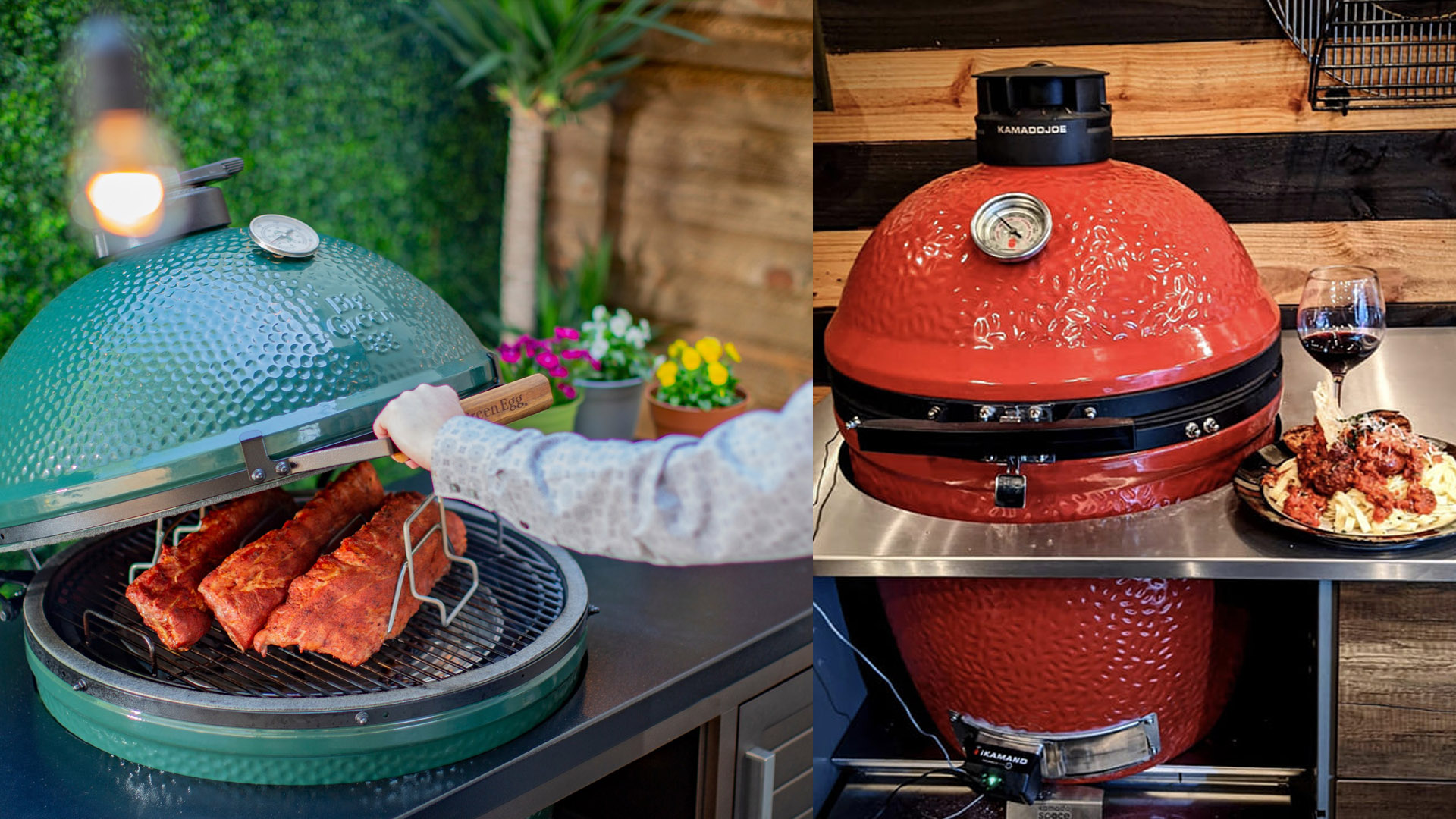
Walk into any serious backyard cook's setup and you will eventually find one of two things sitting on the patio like a quiet piece of sculpture: a round, ceramic vessel that could pass for an alien artifact, either green or red. One is from Atlanta. The other is from suburban Georgia. Both will cook a brisket low and slow for eighteen hours without complaint, and both will sear a ribeye at temperatures that make conventional grills look like Easy-Bake ovens.
This is not a spec sheet. Specs are boring, and you can find those anywhere. This is about what it actually means to own one of these things — the real-world feel of it, the hidden costs, the cooking philosophy baked into the design — so that when you drop $1,200 or more on a grill, you know what you are getting into.
The short version: they are both exceptional. The long version is why you are here.
FEATURED: We were recently mentioned over at Throttle and Rust!
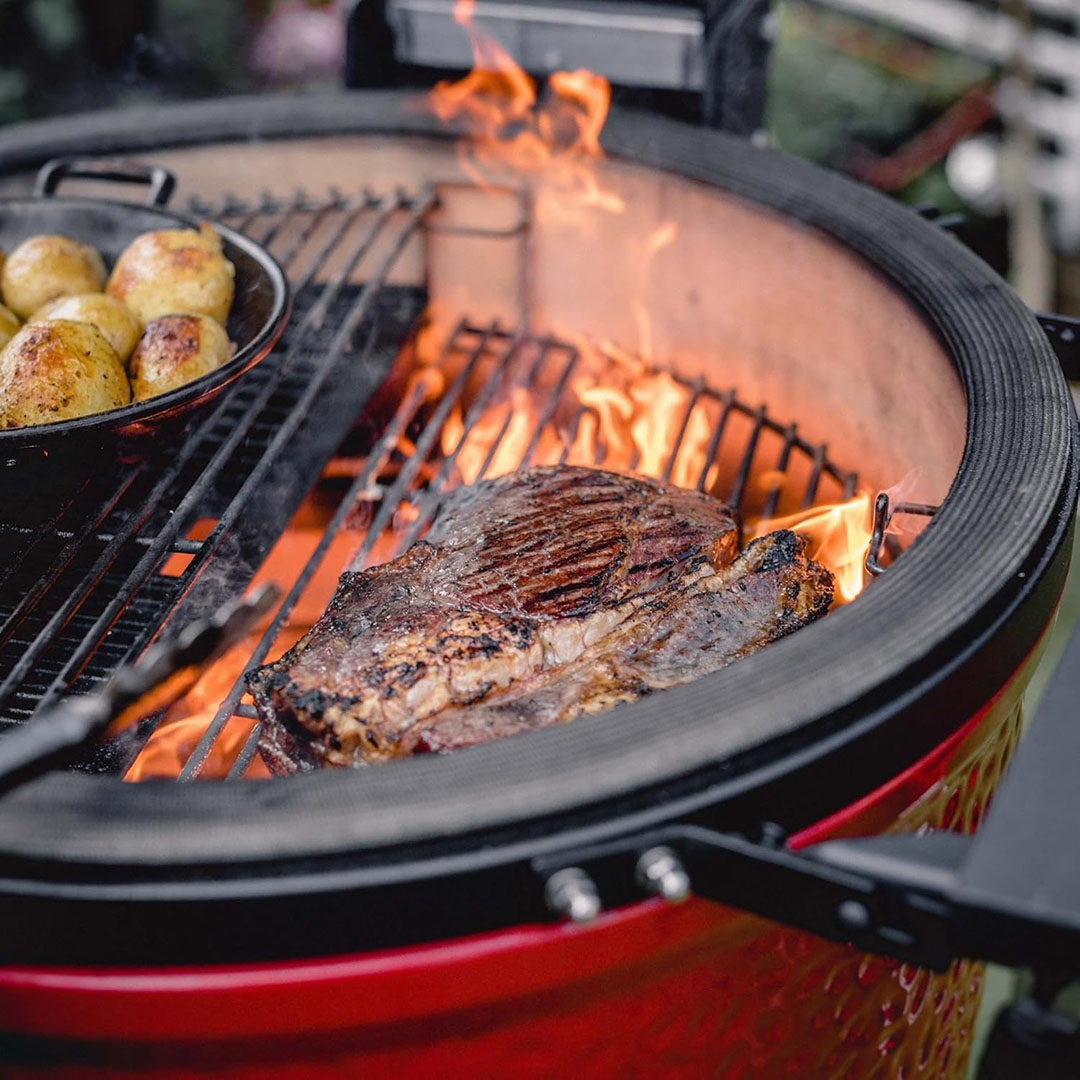
The Classic II is the grill that convinced a lot of backyard cooks to finally ditch the gas. Eighteen inches of thick-walled ceramic that runs from a 225°F all-day smoke to a 700°F sear without breaking a sweat. The Divide and Conquer rack system lets you cook two things at two temperatures at the same time. The Kontrol Tower vent holds your airflow when you open the lid. The dome lifts with one finger. Cleanup is a slide-out drawer.
It ships with the heat deflector included. That detail alone separates it from most of the competition.
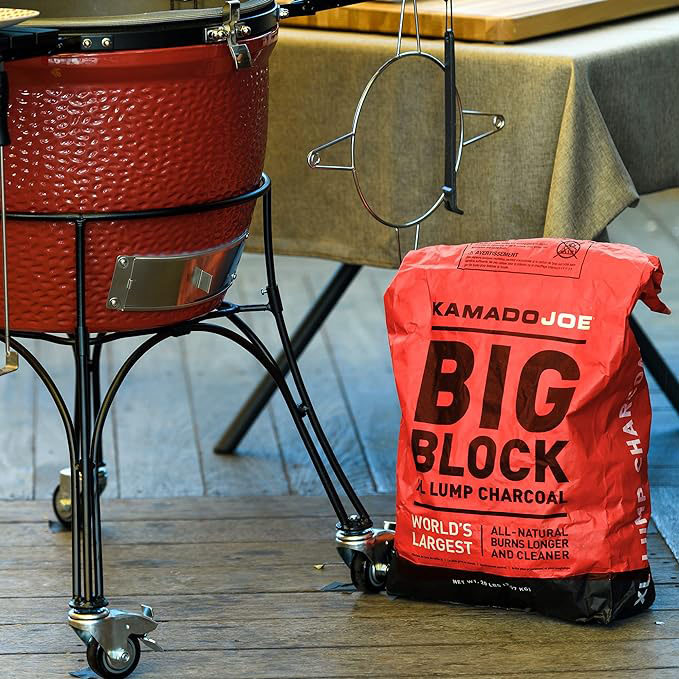
The charcoal that actually lives up to what the grill promises. Kamado Joe's Big Block XL is sourced from Argentinian hardwood masters working with dense woods the locals call "Axe Breakers" — guayacan, guayaibi, mistol, and white quebracho — roasted in traditional outdoor ovens until nothing remains but clean-burning fuel. No fillers, no scrap wood, no chemical binders. It burns up to 18 hours, hits searing temperatures above 750°F, and because the chunks are large and dense, you can close the vents when you are done and reuse what is left up to three times. Twenty pounds goes further than it sounds.
Works in any kamado — Kamado Joe, Big Green Egg, all of it.
The Kamado: A Brief History Worth Knowing
The kamado grill is not an American invention. It is a descendant of the mushikamado, a Japanese clay cooking vessel that goes back roughly 3,000 years. American servicemen encountered it after World War II and brought the idea home. Ed Fisher, a businessman in Atlanta, started importing them in the mid-1970s during a recession — selling them out of a storefront by creative word of mouth — and eventually built the Big Green Egg around them. Kamado Joe came later, founded in 2009, and immediately went after the market with a different pitch: more innovation, more included accessories, and aggressive pricing.
Knowing that history matters because it tells you something about the character of each brand. Big Green Egg is the original. It is the name your father-in-law uses as a verb. Kamado Joe is the challenger that showed up with better engineering and a chip on its shoulder. Neither of those things is inherently good or bad. They are just true.
The Case for Kamado Joe
Kamado Joe's biggest selling point has nothing to do with marketing. It is the Divide and Conquer Flexible Cooking System, a multi-tier rack arrangement that lets you run different cooking zones at different temperatures simultaneously. If you want to sear a steak at 650°F on one side while finishing chicken thighs indirectly on the other, that is not a hack or a workaround — it is what the grill was designed to do.
The Series III Classic Joe, their flagship mid-size option, comes standard with the full rack system, a split ceramic heat deflector (which Big Green Egg sells separately), a wire mesh fiberglass gasket that will not degrade under normal use, a stainless charcoal basket for cleaner loading and ash management, and the Kontrol Tower top vent that maintains your air setting even when you open the dome — a genuinely clever piece of engineering that keeps you from losing your temperature every time you check the cook.
The Air Lift Hinge is another feature that sounds like marketing until you use it. Ceramic dome lids are heavy. The Air Lift counterbalances the weight so precisely that you can hold it open with two fingers. After years of managing a conventional lid, that matters more than you expect.
For the money-conscious buyer, this is where Kamado Joe wins on paper. You are getting a grill that ships with its deflector plates, its multi-tier rack system, and its gasket. On the Big Green Egg, several of those items cost extra.
Kamado Joe also offers the Konnected Joe, a digital charcoal grill that uses a fan-driven temperature control system to hold precise temps without babysitting. For anyone who has sat next to a smoker for twelve hours adjusting vents, that is not a gimmick. That is freedom.
What Kamado Joe Does Best
Multi-zone cooking, out-of-the-box versatility, value on included accessories, and mechanical innovation. If you cook a wide variety of foods — brisket one weekend, pizza the next, whole fish on a weeknight — the Divide and Conquer system will get used constantly.
The Case for Big Green Egg
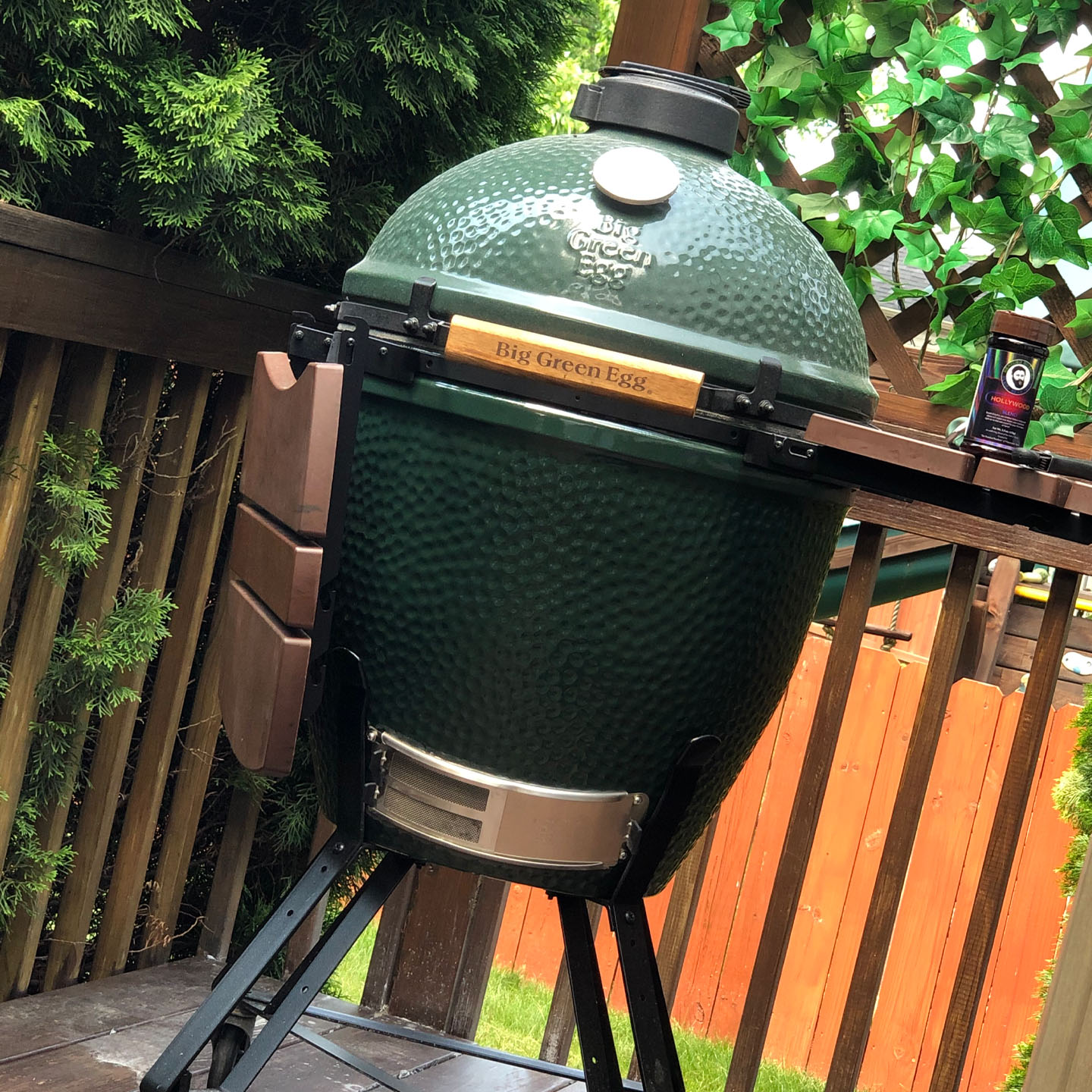
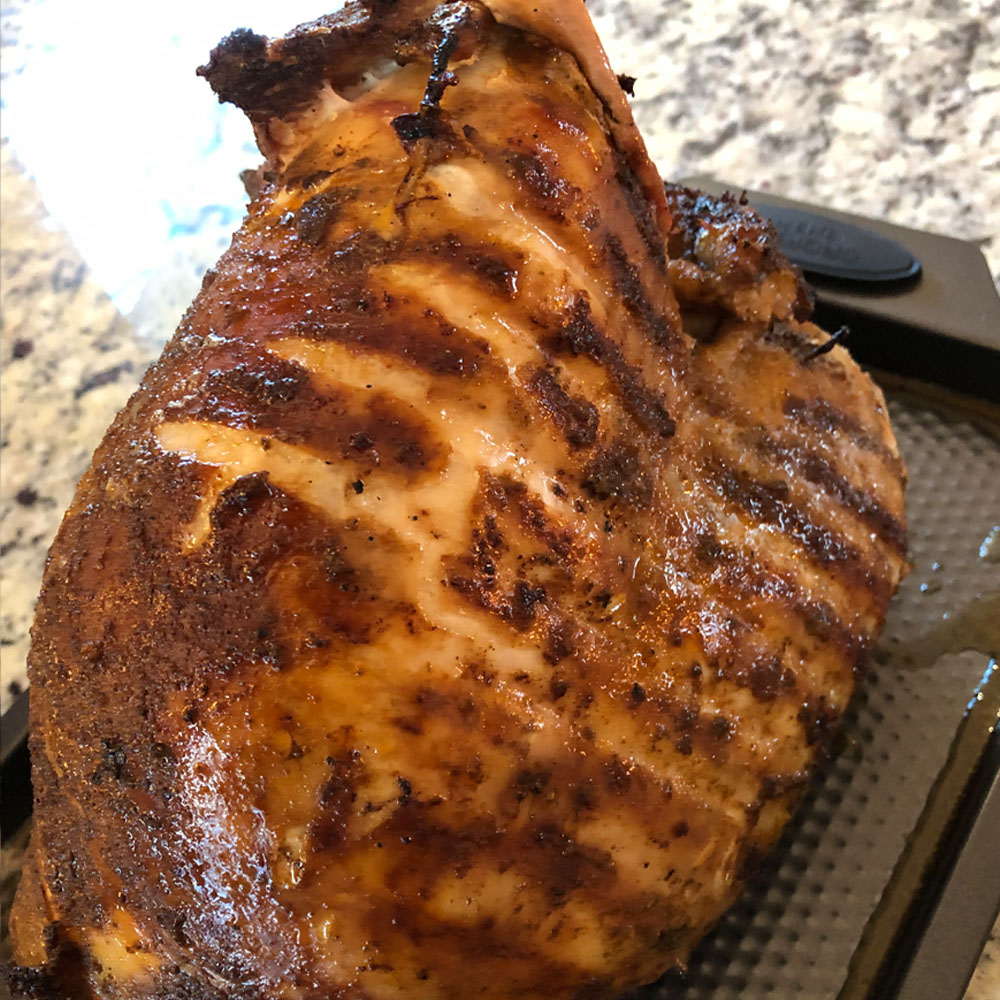
The Big Green Egg does not need to justify itself. It built the American kamado market, and for a very long time it had no serious competition. What it has instead of innovation is refinement: a product that has been dialed in over decades and that the brand backs with an extensive dealer network, wide accessory availability, and a cult following that borders on evangelical.
The ceramic quality on the BGE is excellent. Heat retention is exceptional, and the grill will outlast most of the people who buy it if treated properly. The patented air intake system with its dual-function metal top is simple, direct, and effective — cast iron above, sliding door below — and while the cast iron top vent can rust over time if left exposed (unlike Kamado Joe's cast aluminum Kontrol Tower), most owners manage this fine with basic maintenance.
The BGE's design is purposefully minimal. There is one cooking surface. There are no included plate setters or multi-tier systems in the base package. Some people find that limiting. Others find it clarifying. The argument is that if you know what you are doing on a grill, you do not need the machine to do it for you. That is a philosophy, not a flaw.
In recent years, Big Green Egg began offering package bundles that include a heat deflector, grate lifter, and lump charcoal. This narrowed the accessories gap with Kamado Joe considerably. It also suggests the brand heard the criticism and adjusted — which is not nothing.
The BGE also runs in seven sizes, from the Mini (ideal for camping or small patios) to the 2XL (which can hold six whole chickens at once). The size range is broader than Kamado Joe's lineup, which tops out at 24 inches, while the XL Big Green Egg hits 24 and the 2XL reaches 29 inches of cooking diameter.
What Big Green Egg Does Best
Simplicity, durability, brand ecosystem, and size range. If you want a proven product with decades of accumulated knowledge behind it — cookbook libraries, dealer support, an enormous accessory aftermarket — the Egg is the one with the longest track record.
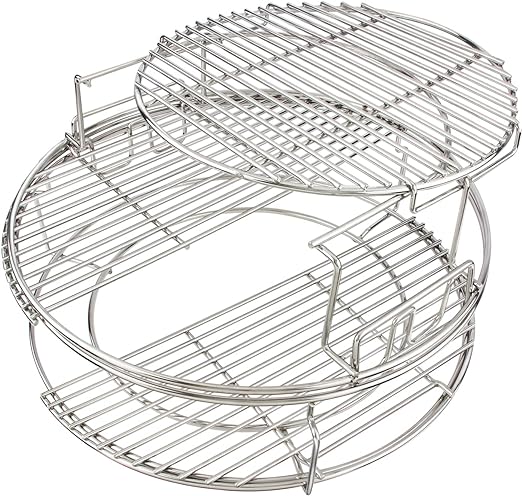
This is the fix for the one thing Big Green Egg owners have always grumbled about — one cooking surface, one temperature, one decision. The KAMaster EGGspander Replacement Kit adds three tiers and five pieces of stainless steel to your Large BGE, opening up over 40 cooking configurations that the grill was always capable of but never set up to handle out of the box. Sear directly over the coals on the lower rack, run indirect heat on the upper level, use the ConvEGGtor basket to swap your heat deflector in and out without dismantling the whole setup. The half-moon grids split so you can run direct and indirect simultaneously. Built from stainless steel, it fits the Large Big Green Egg and comes in at a fraction of what BGE charges for their own branded version.
If you already own the Egg, this is the accessory that finally makes it cook like you always wanted it to.
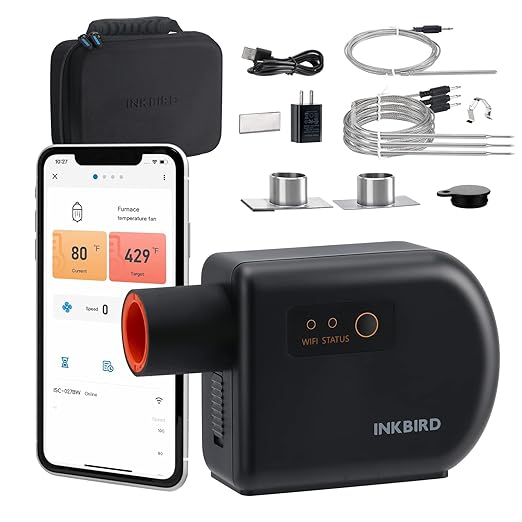
Anyone who has babysit a brisket through a twelve-hour overnight smoke knows the specific misery of waking up at 3am to check the vents. This controller solves that. A fan attaches to your bottom vent, a probe goes in the grill, and the unit automatically adjusts airflow to hold whatever temperature you set — whether that is 225°F for a long smoke or higher for a weekend cook. Connect it to your phone over Bluetooth, set your target temp, and let it run. Open lid detection pauses the fan when you check the food so you do not spike the temperature every time you take a look. Compatible with Big Green Egg, Kamado Joe, Kamado, Primo, Vision, and Akorn out of the box with included adapters.
It does not replace the skill. It just handles the tedious part so you can actually sleep.
Cooking Performance: The Honest Comparison
Both grills run charcoal or wood. Both can hold 225°F for eighteen-hour low-and-slow cooks without drama. Both can hit 700°F and above for searing. The ceramic construction on both is genuinely excellent at heat retention — meaning once the grill is up to temp, it holds there with minimal fuel and minimal adjustment.
In real-world cooking, the differences come down to workflow. The Kamado Joe's multi-level system means you are physically moving less food around and managing more cooking simultaneously. The Big Green Egg, with a single grate, asks you to be more intentional — you set up your cook, you commit, and you manage it with the vents. Neither is wrong. They are just different cooking temperaments.
One note worth making: the BGE has been reported to reach temperature faster on smaller units. Testing in various independent reviews found the MiniMax hitting target temps in roughly twelve minutes. The Kamado Joe Classic II, a larger unit, took around twenty-five — but size accounts for most of that gap. At equivalent sizes, performance is comparable.
The Price Reality
Neither of these grills is cheap. That is stated plainly so you can skip the sticker shock stage.
A Kamado Joe Classic III typically runs in the $1,200 to $1,600 range depending on retailer and bundle. A comparably sized Big Green Egg Large runs anywhere from $1,000 to $1,400 — but that number shifts significantly once you start adding the plate setter, expanded grill system, and other accessories that come standard with the Kamado Joe.
Fully equipped and ready to cook, the real cost difference between the two brands tends to be narrower than the base sticker prices suggest. If you are comparing apples to apples — grill ready to handle both direct and indirect cooking — budget for accessories on the BGE side and factor that into your math.
One useful tip: both brands are sold through Amazon. Pints, Forks & Friends maintains a curated Amazon shop (linked below) where you can browse both grills and their accessories. If you go that route, buying through an affiliate link costs you nothing and helps keep this site running. Fair trade.
Accessories: The Ecosystem Question
This is where brand loyalty gets expensive regardless of which way you go.
Kamado Joe's accessory line is well-engineered and purposeful. The Joetisserie rotisserie attachment is worth having if you cook whole birds. The DoJoe pizza oven attachment is legitimately one of the better ways to make high-heat pizza on a charcoal grill. The pizza stone and grill expander round out a system that keeps adding cooking capability without requiring a second grill.
Big Green Egg's accessory ecosystem is enormous. The ConvEGGtor (their plate setter for indirect cooking) is a must-have and should honestly be included in every base purchase. Their pizza and baking stone produces excellent results. The Vertical Poultry Roaster — essentially a beer-can-style chicken stand — produces the kind of crispy-all-around skin that makes people ask what you did differently. The BGE accessory aftermarket is also massive, meaning third-party options abound at various price points.
Both brands sell covers, tools, charcoal, and a range of add-ons. The practical difference is that Kamado Joe bundles more of the critical items upfront, while the Big Green Egg operates more like a platform that you build out over time.
The Question Nobody Asks (But Should)
Which one will you actually use more?
Both of these grills require a charcoal lighting ritual. You cannot turn a dial and have instant heat. You are managing vents, monitoring temps, and making adjustments. That process is genuinely enjoyable if you treat it as part of the cooking experience. It is a frustration if you just want dinner on the table fast.
If you are the kind of cook who enjoys the process as much as the result — who believes the best conversations happen standing around a grill waiting for a brisket to finish — then either of these will become a fixture in your backyard. If you mostly grill on weeknights after work, you may find a good gas grill serves you better and reserve the kamado for weekend projects.
There is no shame in either answer. Know which one you are before you spend the money.
So Which One Do You Buy?
Buy the Kamado Joe Classic III if: you want more cooking versatility out of the box, you appreciate mechanical innovation, you cook for larger groups and want multi-zone capability, and you want the best value on what is included in the base purchase.
Buy the Big Green Egg if: you value brand heritage and an extensive dealer network, you want the broadest size range including the very large and very small options, you prefer a simpler design and are willing to build out accessories over time, or you already own a BGE and know the ecosystem.
Either way, you are buying a grill that will outlast most of the other equipment in your backyard. Either way, the brisket will be better than anything your gas grill ever produced. Either way, you will spend more time outside, which is exactly where food is supposed to happen.
Before You Go
If you are serious about outdoor cooking and want to stay dialed into the craft beer, food, and grilling world without wading through noise, the Pub Ring Newsletter is where that conversation happens. Free to join, no spam, just the kind of content that makes your next cookout better.
Join the Pub Ring Newsletter — it costs nothing and the company is good.
Browse both grills and accessories at the Pints, Forks & Friends Amazon Shop
STOP SCROLLING FOR WHERE TO GO. WE'LL TELL YOU.
The Pub Ring gets you into the bars and kitchens actually worth your time, plus a stamp card that turns showing up into something you get rewarded for. Join Free.

The Latest...
Ohio Brewery Events This October: Cider in Geneva, Rye in Dayton and Fresh Hops in Chagrin Falls
October in Ohio does something to a beer drinker. The air...

Meet Hops: Our AI Sommelier for Beer, BBQ and Wings
Hops is the Pints, Forks & Friends AI sommelier. He lives...
Anchor Brewing Is Reopening: Here’s What We Know
Fritz Maytag at Anchor Brewing Company | Photography...